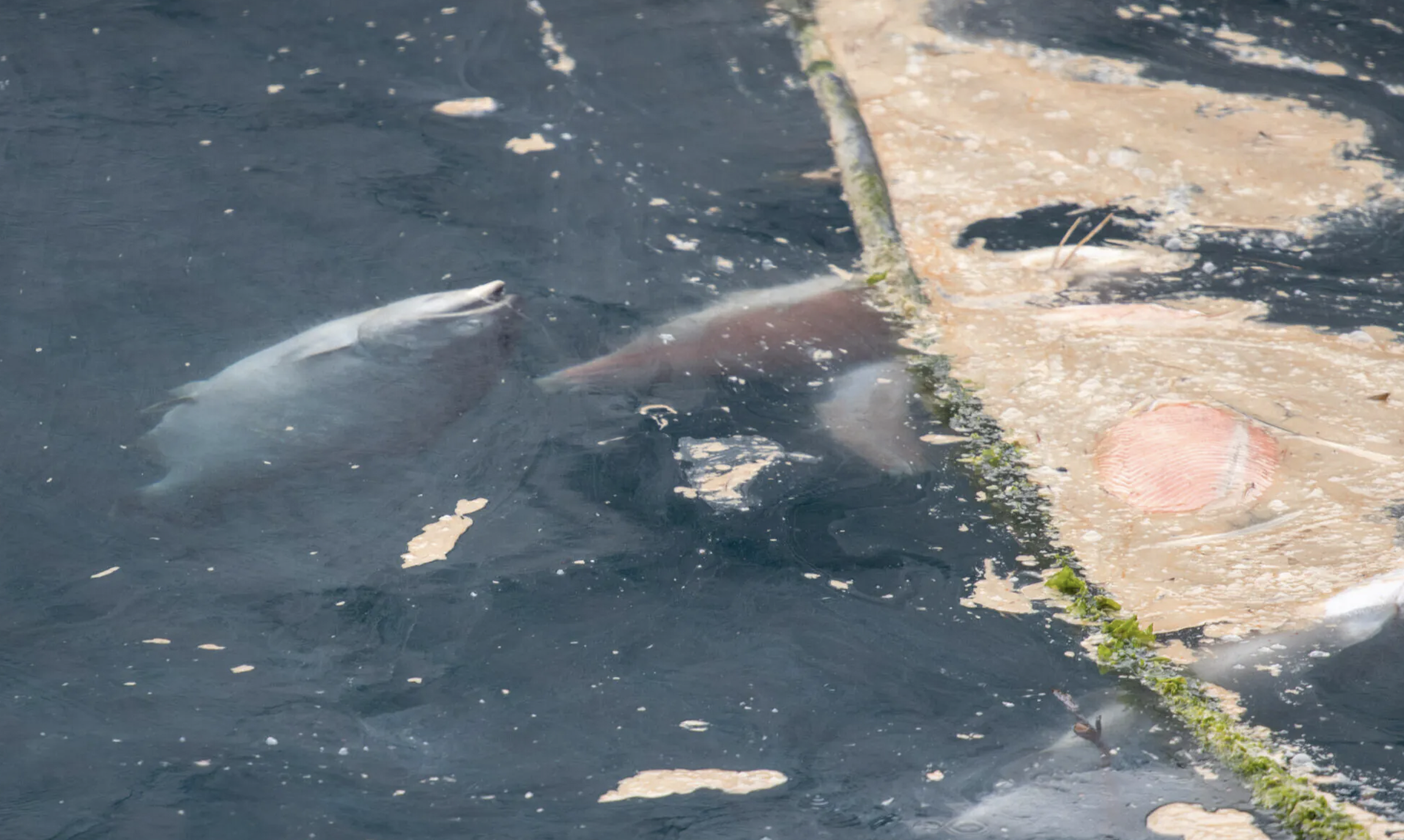
Scientific evidence demonstrates that fishes are intelligent, emotionally complex animals capable of experiencing pain, fear, distress, and positive emotional states. Despite being recognised as sentient under New Zealand’s animal welfare legislation, millions of fishes are exploited in intensive factory farming systems every year.
They can learn from experience, recognise other fishes, communicate, and even use tools. And like all animals, fishes deserve the opportunity to express their natural behaviours and live free from exploitation.
Yet on fish farms, these needs are routinely denied.
What are fish farms?
Fish farms are underwater factory farms. Thousands of fishes are confined in cages where profit and production are prioritised over their wellbeing.
Fishes are typically bred in hatcheries before being transferred to cages in sea or freshwater farms where they are raised for consumption. Here in New Zealand, Chinook (King) salmon is the most commonly farmed fish species.
What’s wrong with fish farming?
Unlike wild fishes, farmed fishes cannot escape overcrowding, poor environmental conditions, disease outbreaks, or stressful handling practices.
Trapped in a life of confinement, farmed fishes can be subjected to:
- Overcrowding
- Poor water quality
- Rapid spread of parasites and disease
- Skin lesions
- Skeletal deformities
- Heat stress
- Inability to escape predators
- Chronic stress
- High mortality rates
Fish farms exist for one purpose: Breeding animals for profit. In these systems, sentient beings are confined for their entire lives before being slaughtered for human consumption. And like all factory farming systems, fish farms deny animals the opportunity to live freely and express their natural behaviours.
The science of fish sentience
Scientific understanding of fish sentience has advanced significantly in recent decades. Research has shown that fishes possess pain receptors, respond to injury in ways consistent with pain perception, and are capable of experiencing a range of affective states.1
Dr Donald Broom, Emeritus Professor of Animal Welfare at the University of Cambridge2 explains:
“The scientific literature is quite clear. Anatomically, physiologically and biologically, the pain system in fish is virtually the same as in birds and mammals.”
As sentient beings capable of suffering, fishes deserve the same compassion and consideration we extend to other animals.
Why is this happening in Aotearoa New Zealand?
Legal protections are falling short
New Zealand’s animal welfare legislation recognises fishes as sentient animals and requires their welfare needs to be protected. Yet farmed fishes remain some of the most neglected animals within the animal welfare regulatory system.
Despite repeated reports of mass mortality events on fish farms, regulators have failed to implement safeguards that would prevent these incidents from occurring. This lack of prevention and accountability leaves millions of farmed fishes vulnerable to exploitation and mistreatment.
Expansion threatens even more fishes
The Fast-track Approvals Act has made it easier for large-scale developments to gain approval while limiting opportunities for the public to have a say. By bypassing standard democratic processes and reducing scrutiny, this legislation risks prioritising development speed over careful consideration of broader impacts.
At the same time, Government Ministers and MPI are actively promoting the growth of New Zealand’s fish farming sector despite ongoing concerns about breaches of animal welfare legislation. Expanding an industry with well documented welfare and mortality issues risks condemning even more sentient animals to lives trapped in underwater factory farms.
SAFE’s position
Fishes deserve the same protection and consideration as all other animals. As sentient beings capable of suffering, fishes should not be confined in intensive farming systems.
We are calling for an end to factory farming in Aotearoa New Zealand, and an immediate half to all proposed fish farm expansions and new developments.
What can we all do to drive change?
Choose fish-free alternatives
One of the most effective ways to help fishes is to leave them off your plate. Choosing plant-based alternatives reduces demand for both fish farming and commercial fishing.
Speak up
- Sign SAFE’s petition to end factory farming
- Support campaigns that protect fishes
- Oppose proposals that would expand fish farming through formal submission processes (join our Animal Action Network)
- Share information about fish welfare with your friends and family