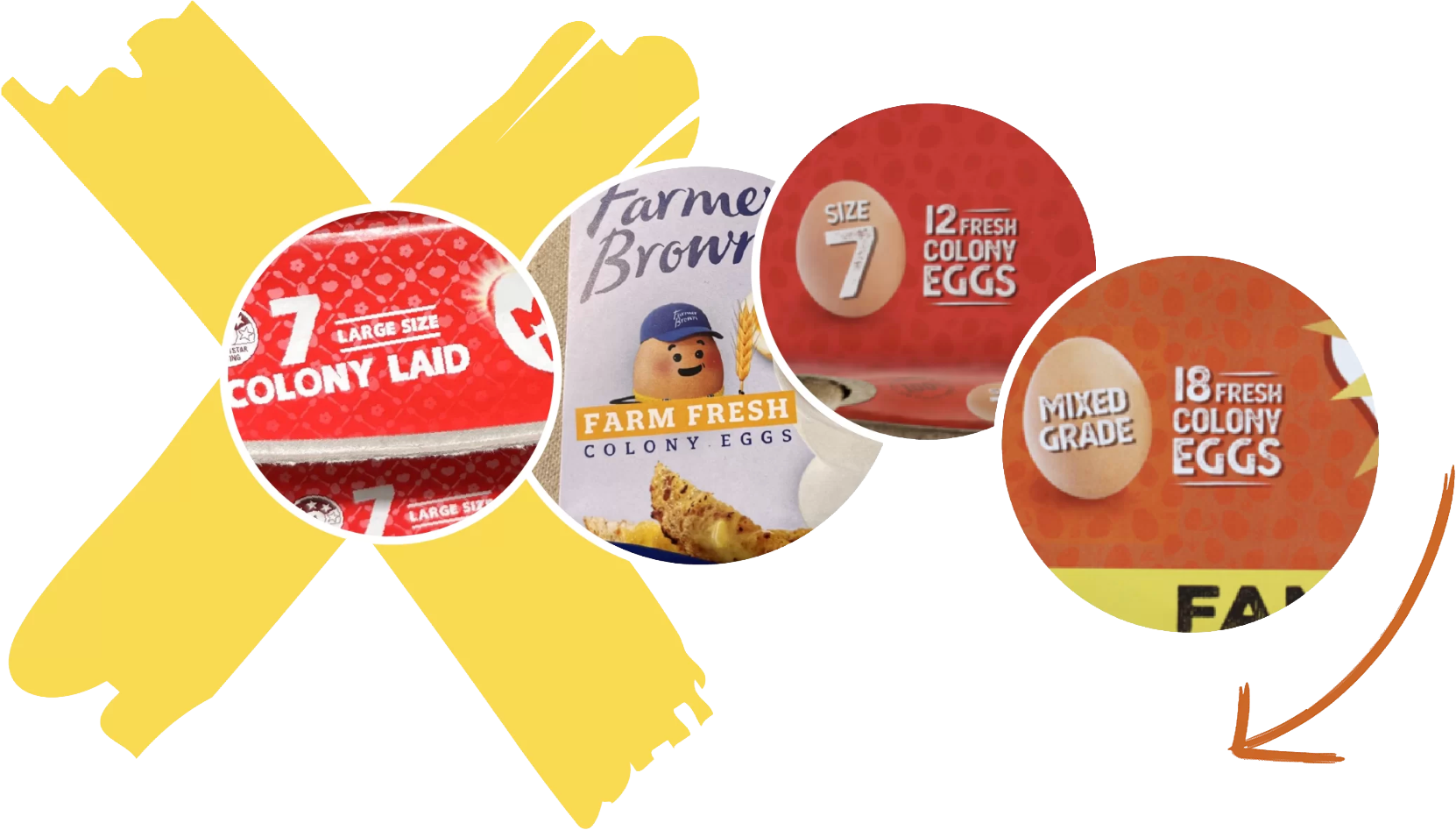
Right now, millions of cage eggs are being sold across Aotearoa without the word ‘cage’ featured anywhere on their packaging. In fact, all cage eggs sold in New Zealand are marketed with vague labels like ‘colony’ or ‘colony laid’ – and fail to feature the word ‘cage’ anywhere on their packaging.
Long story short…
‘Colony laid’ eggs are cage eggs
It seems the New Zealand cage egg industry knows exactly how strongly Kiwis oppose cruel and outdated cage farming systems. So much so, that the industry appears to rely on misleading Kiwis with confusing packaging to sell its products.
If the industry had nothing to hide about the conditions it subjects hens to, it would label its cartons honestly – using the word ‘cage’ – instead of hiding the facts behind sunshine and love hearts (yes, really – those images actually appear on some cage egg packaging). Their refusal to be transparent says it all.
Misleading labels on cage eggs aren’t just bad marketing – they’re a potential breach of the Fair Trading Act. Even worse, this lack of transparency allows the cage egg industry to quietly continue operating under the radar.
New Zealand’s history of caging hens
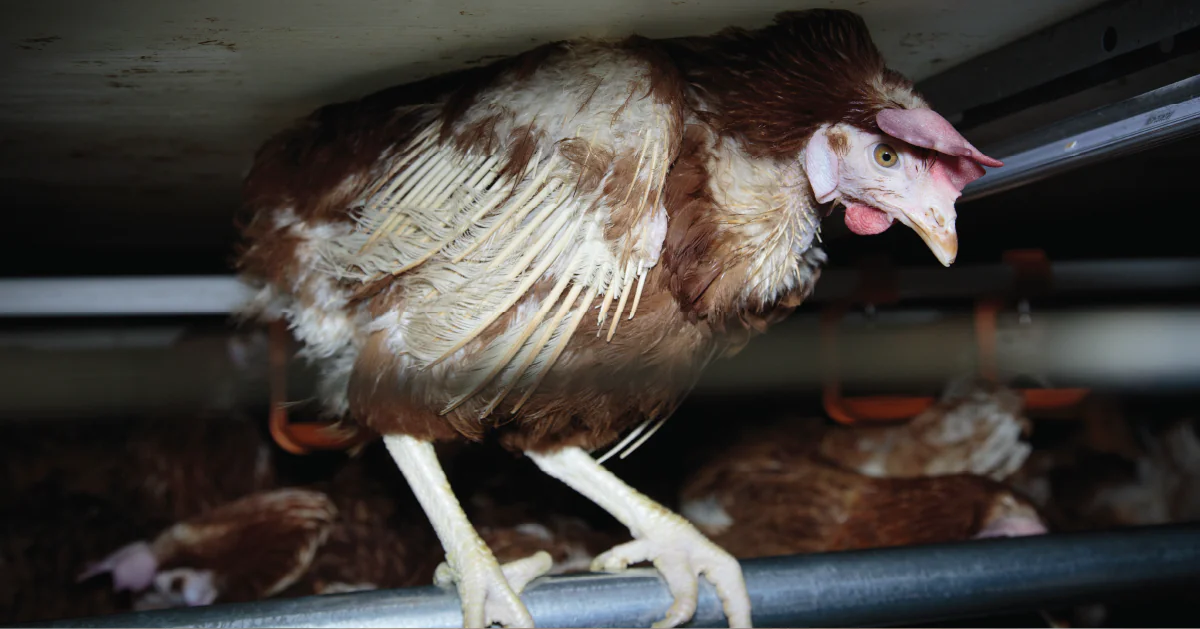
On January 1, 2023, battery cage systems were finally banned in New Zealand after a ten-year phase out period. This ban was announced in 2012 after the New Zealand Government recognised the use of battery cages violated the Animal Welfare Act 1999, because they prevented hens from expressing normal behaviours.
In 2012, the updated Code of Welfare for Layer Hens confirmed the ban on battery cages but introduced equally problematic ‘colony’ cages as their replacement. This decision was a devastating blow for hens and a staggering failure by the New Zealand Government. Rather than prioritising animal welfare, the code pushed hens from one cage into another. The introduction of colony cages in Aotearoa clearly favoured industry interests, and millions of hens have suffered as a result. If the government of the day had ensured that farming systems aligned with the Animal Welfare Act, tens of millions of hens could have been spared this ongoing misery.
So, what’s the difference between a Battery Cage and a Colony Cage?
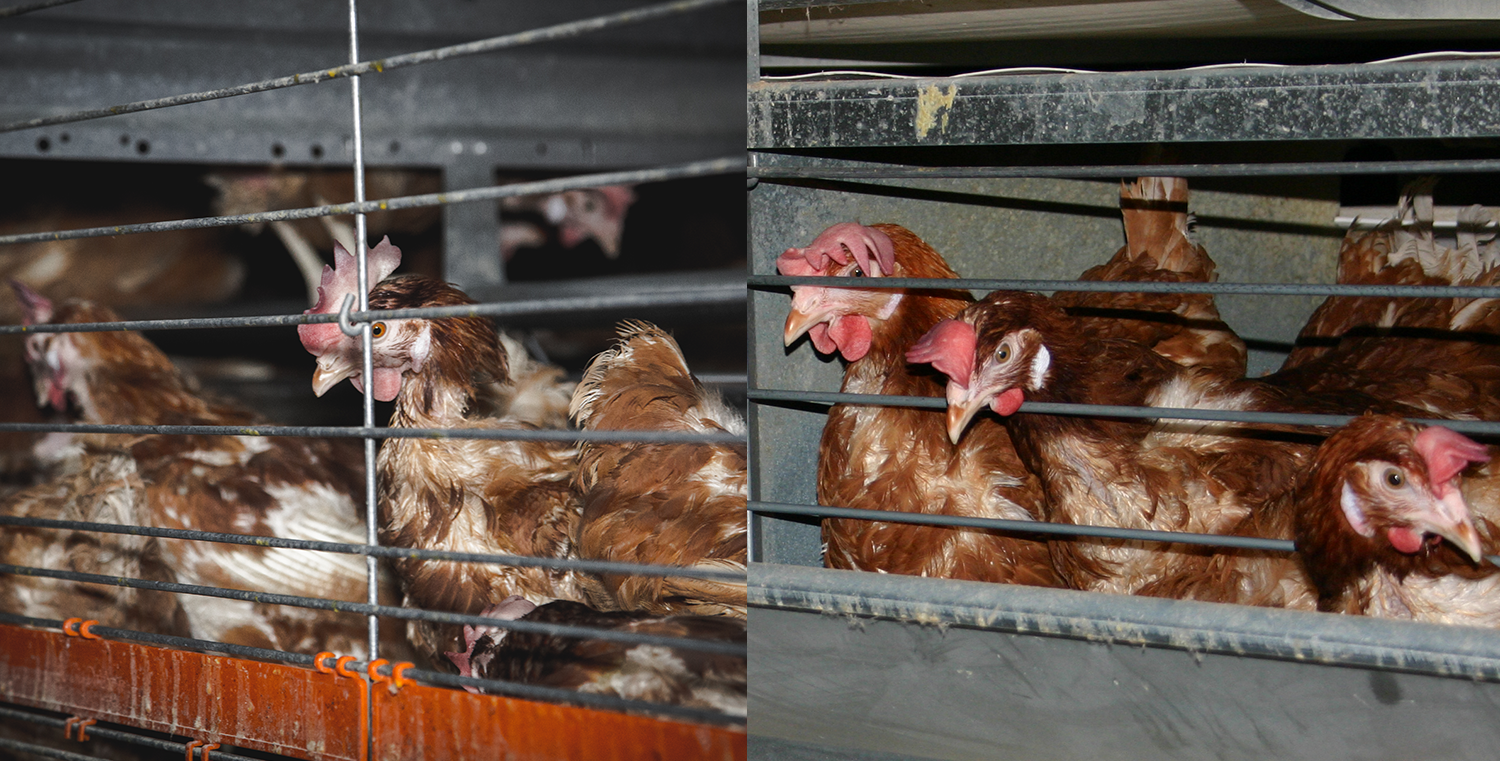
Despite what the egg industry would have you believe – very little. The use of colony cages breaches New Zealand’s Animal Welfare Act, as they prevent hens from expressing normal behaviours (the same reason battery cages were banned). Despite this, one-third of hens farmed for eggs in New Zealand are still confined to cruel colony cages. If you want to learn more, we’ve broken it down for you here…
Our complaint to the Commerce Commission
In March 2024, SAFE commissioned an independent poll to understand how Kiwis perceive current cage egg labelling. The results confirmed our concerns: 84% of New Zealanders did not realise that ‘colony laid’ eggs come from caged hens, and 72% agreed that the current labelling is misleading.
To address this, SAFE submitted an official complaint to the Commerce Commission in January 2025. We argue that:
Labelling eggs as ‘colony laid’ or ‘colony eggs’ is misleading and fails to accurately describe the farming methods used to produce the eggs.
These misleading labels are a violation of the Fair Trading Act 1986, that states under sc9 and sc10 must not mislead or deceive the public, and under sc13(a) states that no trader must use misleading representation.
The solution to this problem is simple and it won’t cost the industry or consumers anything to implement. SAFE is calling for all caged eggs to be sold with clear and honest labelling that includes the word ‘cage’ on the packaging.
In total, 10,781 caring individuals signed their names in support of our complaint. We submitted this powerful show of public concern to the Commerce Commission as a supplementary document in March. In response, the Commission confirmed that our complaint meets the threshold for investigation.
The matter is now with the Fair Trade Committee, and an investigation is currently underway.
SAFE would like to sincerely thank everyone who took the time to sign our complaint to the Commerce Commission and those who have generously donated to this campaign. We cannot achieve our aim of banning cruel cages in Aotearoa if Kiwis don’t know that hens are still being kept in cages. Thanks to your support, we are one step closer, all while holding the industry accountable and exposing the reality behind cruel cage egg farming systems.