Having positive role models can make all the difference when it comes to embracing – and sticking with – a plant-based lifestyle. Seeing people from all walks of life living in alignment with their values is a powerful reminder that veganism isn’t about fitting a particular mould. It’s a compassionate choice that can be woven into every kind of career, hobby, and lifestyle.
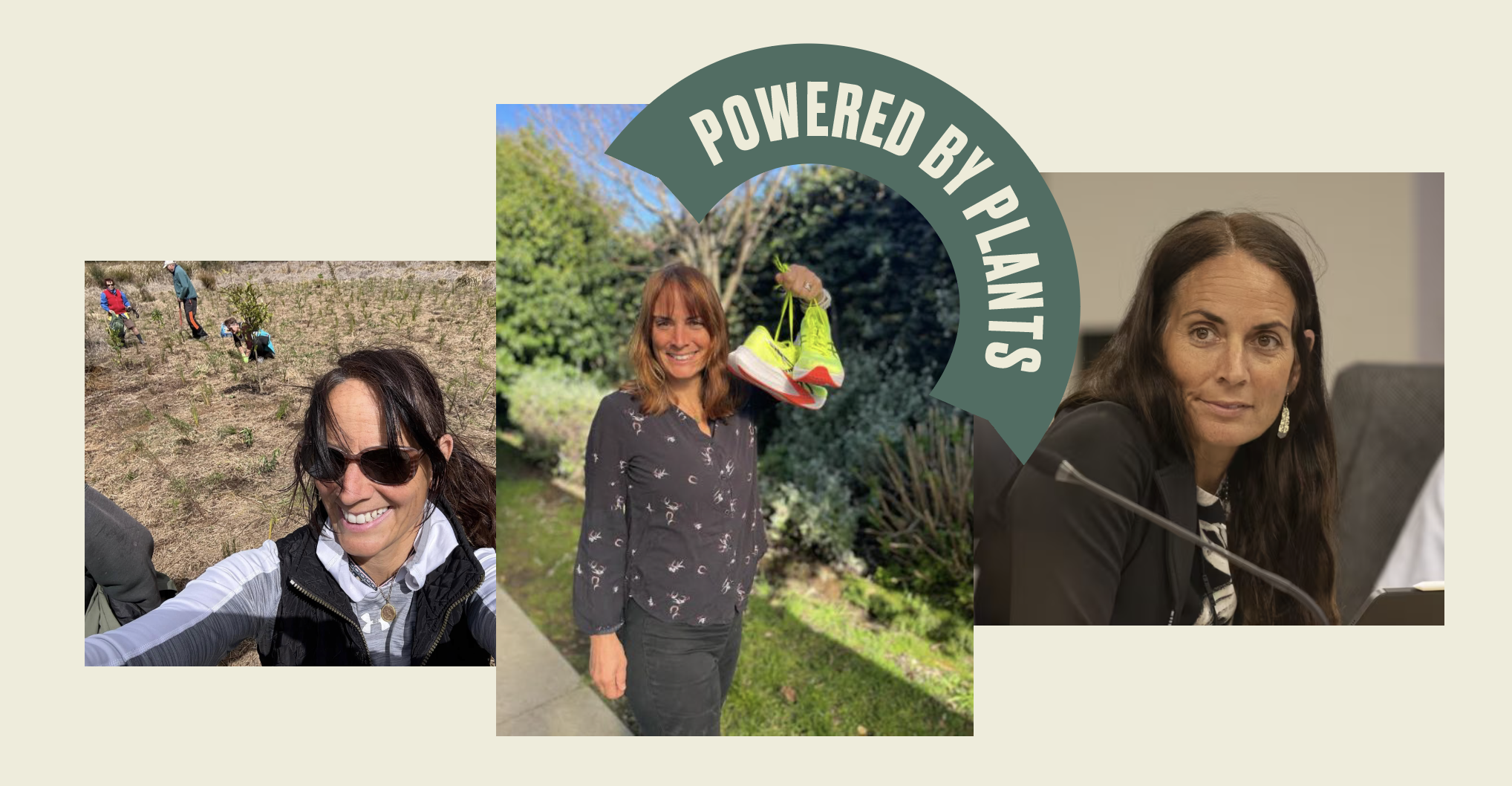
Here at SAFE, we’re fortunate to have exactly that kind of role model leading our Board. Kat Macmillan, our Board Chairperson and a Bay of Plenty Regional Councillor, has dedicated her career to creating positive change for people, communities, and animals alike. A passionate advocate for animal rights, she brings strategic leadership, unwavering compassion, and a deep commitment to building a kinder future.
Kat is also an accomplished long-distance runner, meeting her nutritional requirements with hearty, protein-packed meals and plenty of fruits and vegetables.
We sat down with Kat to chat about her journey to veganism, what inspires her work as a strategic councillor and SAFE Board Chairperson, and how she balances advocacy, leadership, and a love of endurance running.
What’s your earliest memory of connecting with and loving animals?
I remember being about four or five, and saying to my mum, ‘I want to be a farmer, because they get to work with animals’. And my mum said, ‘Oh, did you know that farmers actually have to have their animals killed? And I said, ‘Oh, I don’t want to be a farmer then. What’s somebody who helps animals? And she said, “A vet”. And I said, “I want to be a vet then”.
I think I was probably about five when I experienced this deep core trauma. My dad — who’s Greek, from Crete — was a fisherman by trade. When we were quite young, he had a trawler, and we’d tip all the fish out onto the deck. I’d spend the whole time running around trying to save what they called the ‘junk fish’ — the ones with no commercial value. They were going to die anyway, but I’d try to throw them back over the side, hoping they’d survive.
Back then, I didn’t understand environmental stewardship or anything like that. I just knew it was wrong.
So did you stop eating animals quite early on?
Yeah, when I was about six, I refused to eat animals. But it wasn’t until I was seven or eight that my mum stopped trying to get me to eat them. And I didn’t become vegan until I was about 23, when I started working for an animal rights charity in the UK called Viva!. I had done some voluntary work on dairy farms because I had planned to be a vet, but it’s funny how, somehow, I hadn’t really put it all together in my mind. And then, of course, the minute you see the reality of the dairy industry, then obviously, yeah, there’s no way I was going to have any dairy.
What prompted your move into Council?
I’m a big-picture thinker. Throughout my life, I’ve always thought about changing the food system in terms of transitioning people towards plant-based diets. I’m not saying everyone would become vegan overnight, but if we shifted the dial massively and ended factory farming, we could significantly reduce our impact on the climate. In New Zealand, 51% of emissions come from agriculture. You’d also protect freshwater and help prevent rural sprawl.
George Monbiot talks about this really well — the fact that we deforest land to create pasture for animals, or to grow crops to feed animals, to then feed people. If you cut out the middleman, which is the animal, you simply wouldn’t need anywhere near as much land. And I’m talking globally, as well as in New Zealand. You could reforest and rewild huge areas.
So my drive to go into politics — and specifically the Regional Council — was really about land-use change. Obviously, you can’t go in all guns blazing demanding farmers change their business models overnight. But you can look at how to support transition, improve freshwater outcomes, and ask, ‘Well actually, if we retired some of these intensive dairy farms, what would that mean for waterways?’
My driver was looking at how we create wellbeing economies within planetary boundaries, and asking what levers we can pull to support environmental restoration, better freshwater and climate outcomes, and thriving communities.
Animal rights are overlooked and under-resourced politically. Obviously, you’re approaching it strategically, but how do you raise those issues as a councillor?
Yeah, I mean, animal welfare doesn’t really sit within a regional council’s remit. There have been some issues around pest control, for example. Obviously, some vegans are uncomfortable with that, but if you apply a te ao Māori framework, there are genuine ecological issues in this country — and it’s not the animals’ fault. There are species that don’t belong here, including livestock agriculture.
But when you hear about inhumane practices or invasive animals being treated without respect, that’s something I’ll speak up about. Animals can be really demonised. I’ve even seen it at DOC sites where possums are deliberately shown with these exaggerated ‘beady eyes’ to make them look evil, and it’s like — it’s not their fault they don’t belong in New Zealand.
So occasionally I’ll advocate for animals in that way. But strategically, I don’t tend to frame things around ‘animal rights’ at the Regional Council table. District and city councils deal with animal control, not regional councils, and legislation like the Animal Welfare Act and Wildlife Act sits with central government. So there’s a limit to how much I can bring animal rights into those spaces without it seeming like I’ve come in with an agenda that isn’t really within the council’s role, if you know what I mean.
But I’ll always speak up for animals. If animals come into the conversation, I’ll always advocate for them.
You have to bring strategy to the SAFE board, too: How does it feel being a part of SAFE?
SAFE’s mission is incredibly close to my heart — ending animal suffering is something I care deeply about. Being part of an organisation that works hard to make every donor dollar count is both rewarding and fulfilling for me. I feel really passionate about helping drive a strategy that focuses on the areas where we can make the biggest difference for animals and create meaningful change.
You’re a runner; has that always been a big part of your life?
No, not always. I didn’t start running until I was about 45, but once I began, I got into it very quickly because I’m quite a competitive person. I’d say I’m an older runner, but still competitive in my age category.
I started with parkrun, the 5km community events, and became really involved in that community. Before I knew it, I was running marathons and ultra-marathons.
I’m really passionate about health and wellbeing — exercise, diet, fitness, and longevity — and about maintaining a good quality of life for as long as possible. Of course, some people have the odds stacked against them, but I strongly believe in prevention rather than waiting until people become seriously unwell. If you can eat well and push yourself physically, it can make a huge difference to your health.
What do you love most about running?
What I love most is the whole running community, especially trail running. Trail runners tend to love the environment and being out in nature, so there’s that shared connection. We also enjoy pushing ourselves beyond what we thought were our limits. Racing is challenging, but it’s incredibly rewarding.
“When you’re running 100 km or even 100 miles competitively, what you put into your body really matters. You can’t rely on shortcuts with nutrition — you need a genuinely good diet to perform and recover well.”
There are actually a lot of vegan and plant-based athletes in the endurance and ultra-running world because nutrition becomes so important. When you’re running 100 km or even 100 miles competitively, what you put into your body really matters. You can’t rely on shortcuts with nutrition — you need a genuinely good diet to perform and recover well. Maybe ultra-runners in their early 20s can get away with more, but as you get older, good nutrition becomes even more important. Plant-powered is kind of my mantra.
Your sport, the way you live your life, and the way you connect with nature can have such a huge impact on your wellbeing. I’m 52 now, so I’m in the perimenopause stage of life, and that’s another reason why I believe in continuing to push myself and keep getting out there. Staying active can really help you through that stage where your body is changing.
I want women to know that menopause doesn’t mean you have to stop doing amazing things. I’m really passionate about showing that you can still challenge yourself, compete, and achieve incredible things at any stage of life.
What I eat in a day
For breakfast, I have homemade muesli with soy milk. I make my muesli with lots of nuts and seeds for maximum protein and dried fruit for sweetness. I include oats, pecans, cashews, pumpkin seeds, linseeds, large raisins, and coconut flakes.
For lunch, it’s usually a simple noodle soup or a chickpea or butter bean salad with toast. Or leftovers. Lunch isn’t a huge meal for me, and I like to keep it light and easy to digest. Sometimes I squeeze a run in around lunchtime, so I don’t want heavy food sitting in my stomach.
I usually have a big dinner. I love that with ultra-running training, you can pretty much keep fuelling up. I love eating! My favourite is pasta with tofu, chickpeas, avocado, steamed spinach, asparagus, roasted capsicum, and lots of extra virgin olive oil and balsamic vinegar. For the tofu, I chop it into cubes, drizzle it with soy sauce, and fry it with turmeric and paprika. We call this meal ‘Pasta-Av’, and it’s a favourite family meal. I need lots of carbs for endurance running, and our sons grew up on it. They often cook it themselves in their student flats because it’s so easy, cheap, and packed with carbs and protein.
Snacks during the day are usually fruit and/or an additional bowl of muesli.