
One year on: Mud farming continues to condemn animals to suffering and death
September 10th, 2025In September 2024, SAFE helped to expose harrowing footage of dead and dying sheep on a Southland mud farm. The footage gained national attention, raising serious concerns about the ethics of intensive farming practices. Federated Farmers dismissed the tragedy as the result of “bad weather.”

Image and footage by Matt Coffey, 2024
This September, new footage from the very same farm shows that nothing has changed.
What the new footage reveals
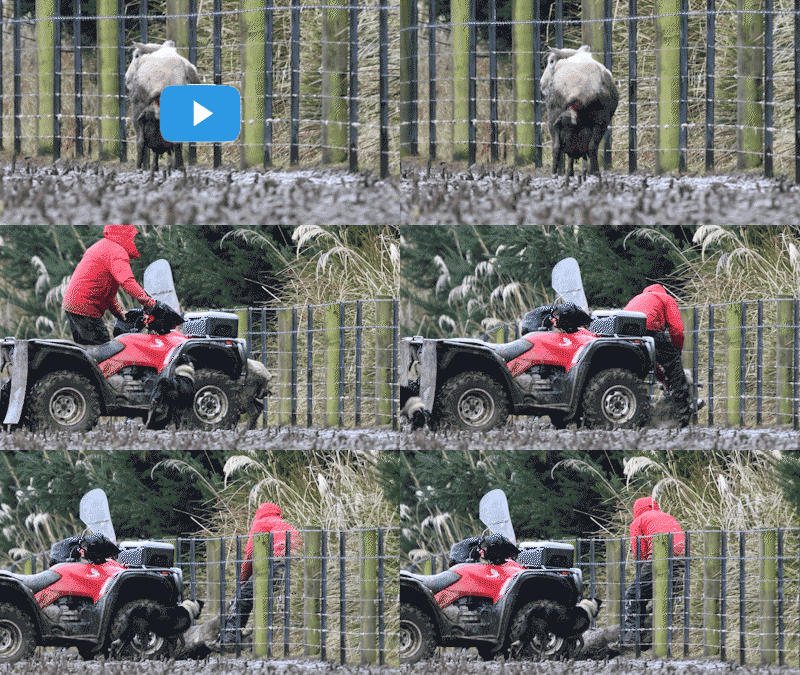
Filmed between 5–6 September 2025, the footage shows a sheep likely struggling to give birth, her lamb’s head visibly stuck. The farmer forcibly pushes her to the ground, drags her through a fence, and takes her out of sight into a nearby bush. At first, she is upright and alert; moments later, she appears lifeless. We don’t know what happened to her next.
The following day, at least two dead newborn lambs were found lying in mud.
For SAFE, the most disturbing part is not only what the footage shows, but what it doesn’t. A sheep in labour was dragged out of sight at the very moment she most needed help. The unanswered question of what happened next is as haunting as the cruelty captured on film.
Footage captured by Matt Coffey
The “bad weather” myth
This farm is now a repeat offender. In 2024, footage from the same property showed multiple sheep dead and others visibly caked in mud and shivering in the cold. At the time, the industry brushed it off as farmers being “caught out” by bad weather.
But this year has been significantly drier – and animals are still dying. The claim that the dangers of mud farming are limited to extreme weather events simply doesn’t hold up. The risks are inherent to the practice itself.
Mud farming explained
Mud farming forces animals to live, sleep, and give birth in crop paddocks that quickly turn to mud under the pressure of hundreds of hooves. These paddocks become saturated with mud, faeces, and urine, leaving animals with no clean or dry ground to rest on. Prolonged exposure to wet, muddy conditions comes with a range of well-documented welfare issues, from lameness and infections to hypothermia and death.
For newborn lambs, the stakes are higher. Their small bodies lack the reserves to cope with cold temperatures, leaving them at risk of death within their first moments of life. Pregnant sheep are naturally driven to find a safe, sheltered spot to give birth and care for their lambs. On mud farms, they don’t have a choice. Instead, they’re left to endure the most vulnerable moments of their lives in filth.
This new footage shows these risks playing out in real time: lambs unable to survive the conditions they are born into, and their mothers struggling in pain.
A systemic failure
New Zealand’s Animal Welfare Act requires that animals’ basic needs are met and that they are handled in ways that prevent unnecessary pain and distress. Conditions such as those revealed on this farm are completely inconsistent with those obligations.
The Ministry for Primary Industries (MPI) is charged with enforcing the Animal Welfare Act, and the dangers of mud farming are no secret. They have been documented time and again by animal welfare experts and MPI’s own reports. Yet they have repeatedly failed to act. That failure has enabled systemic neglect to continue unchecked. Laws on paper mean nothing if they are not enforced.
This is not about one farmer. It’s about a system that allows animals to suffer year after year, with no meaningful consequences for those responsible.
It’s time to end mud farming
No animal deserves to give birth or die in mud. But sadly, it is the inevitable outcome of mud farming everywhere, and it will keep happening until the practice is banned.
Sheep and lambs are more than numbers in a system. They are living, feeling individuals who deserve to live with dignity. New Zealanders have already spoken out, with more than 17,000 people joining the call to end mud farming. Together, we can push the Government to listen and act.
A better future for animals is possible, but only if we demand it:
Sign the petition to end mud farming
What else you can do
Ending mud farming will take more than outrage – it will take collective action. Here’s some more powerful ways you can help:
- Share the footage: Most people in Aotearoa have never seen what mud farming looks like. By sharing footage with your friends, whanau, and networks, you can help raise awareness and build public pressure for change.
- Call for a Commissioner for Animals: SAFE is also campaigning for animals to have an independent voice in the halls of power who can address systemic cruelty like this.
- Donate to support SAFE’s investigations: SAFE’s investigations expose the hidden reality of animal suffering, from mud farms to factory farms. With your support, we can continue to shine a light on cruelty that the industry wants to keep in the dark.
We are grateful to Matt Coffey, whose dedication to documenting mud farming has made it possible to expose this cruelty to the public.